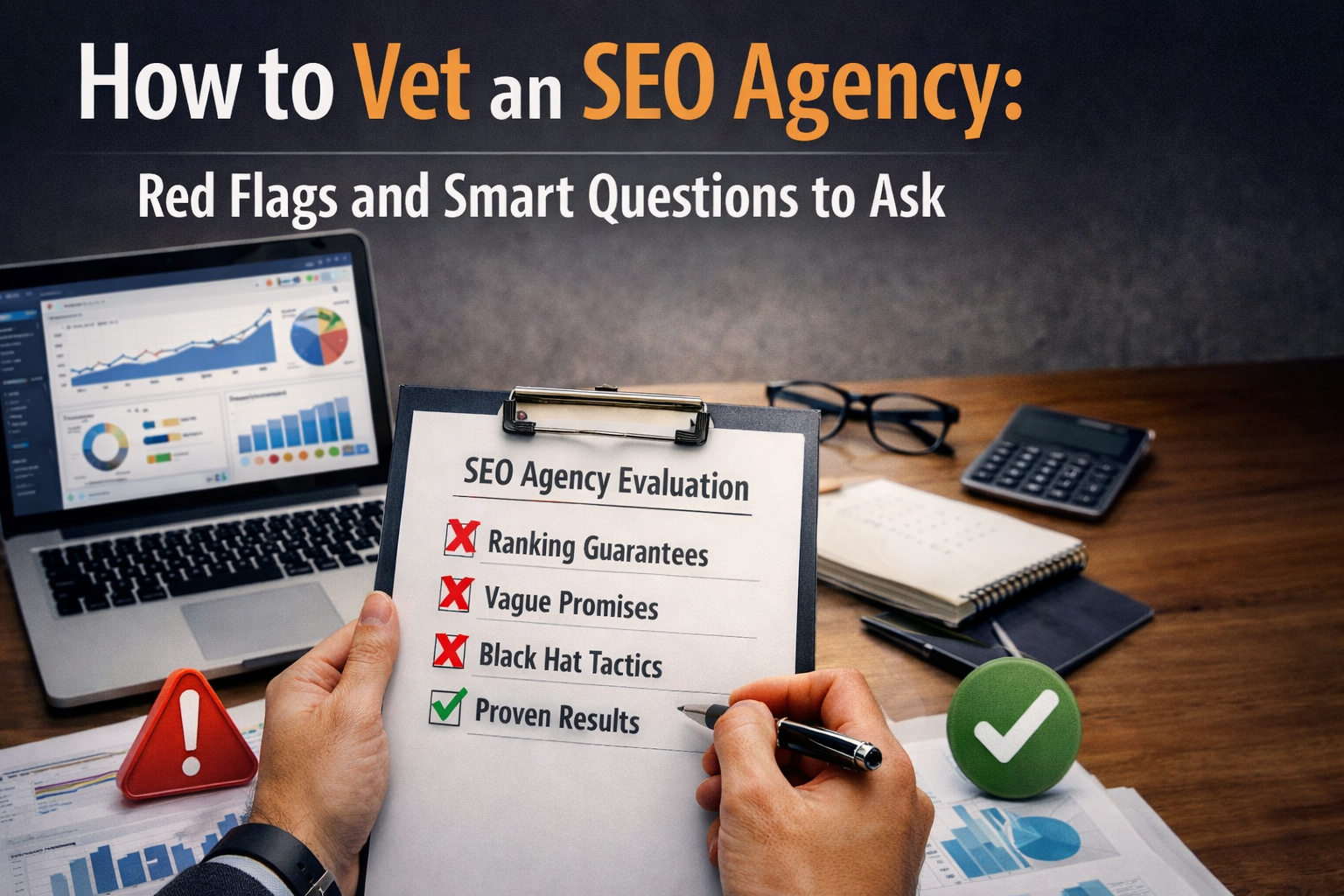
Choosing an SEO agency isn’t just a marketing decision. Hiring the wrong agency or consultant can hurt your rankings, weaken your brand, and leave lasting damage that takes months or even years to fix.
This guide shows you how to spot warning signs early and ask the right questions so you can separate real expertise from polished sales pitches.
First, Let’s Talk About What “Real” SEO Looks Like
Before you can spot a bad agency, you need a sense of what good SEO actually entails.
A credible agency will:
- Focus on business outcomes, not just rankings or traffic, and talk about conversions, leads, and revenue as core goals.
- Combine technical SEO, content strategy, and authority building (links, PR, brand) instead of focusing on one silver bullet.
- Be transparent about methods, timelines, tools, and limitations, and avoid guarantees or “secret sauce” explanations.
A good SEO agency should explain how they improve visibility and help businesses reach more potential customers, including strategies like local business exposure opportunities that strengthen authority over time.
If an agency can’t articulate a thoughtful, multi‑layered strategy in plain language, they probably don’t have one.
Major red flags: When to walk away
These are patterns that should immediately make you cautious.
1. Guaranteed rankings or fast results
- Promises like “#1 on Google in 30 days” or “guaranteed first‑page rankings” are classic scam signals; Google explicitly states no one can guarantee rankings.
- “Limited‑time SEO offers” tied to guarantees and aggressive deadlines are often wrappers for minimal or spammy work.
Why it’s a problem: Agencies that guarantee rankings usually chase meaningless vanity keywords or use risky tactics that can get you penalized.
2. Vague, secretive, or buzzword‑only process
- They say their methods are “too complex” to explain or rely on boilerplate jargon that never gets specific to your site and market.
- They dodge questions about tools, tactics, or how they’ll measure success, insisting you just “leave it to the experts.”
Real pros can explain their process step‑by‑step in plain English and tailor it to your situation.
3. Black‑hat or low‑quality tactics
Watch for:
- Buying backlinks, link exchanges, or mass submissions to low‑quality directories.
- Keyword stuffing and doorway/gateway pages created solely to rank, not to serve users.
- Negative SEO (building toxic links to competitors) or other manipulative tactics.
These approaches might move the needle short term, but they risk penalties and long‑term damage to your domain and business.
4. Obsession with traffic, not revenue
- They lead with “we’ll 10x your traffic” but can’t connect that traffic to sales, leads, or qualified inquiries.
- Reporting is all vanity metrics—impressions, clicks, rankings—without tying them to business KPIs.
You want an agency that talks about profitability, customer LTV, and lead quality as naturally as they talk about keywords.
5. No foundation or strategy upfront
- They skip discovery and do not investigate your positioning, margins, constraints, or sales process, or even bother to look at past work; instead they try pushing pre‑built packages.
- There’s no mention of technical audits, content audits, or competitive analysis before “starting SEO.”
Good agencies insist on groundwork: that includes past work done, technical checks, analytics review, and strategic planning before starting monthly tasks.
6. Cookie‑cutter deliverables with no flexibility
- You’re offered rigid packages like “2 blog posts and 2 backlinks per month” with no room to shift resources as priorities change.
- Strategy never evolves; they keep doing the same checklist even when results plateau.
Effective SEO is not a check list or a bulk order of cheap backlinks; it is a long-term strategy built on relevance, trust, and consistent value.
7. Poor communication and reporting
- Only automated reports, no regular strategy calls or real discussion of what’s working and what’s not.
- Slow, unclear communication; your emails sit for days and reporting feels like an afterthought.
Green flag: scheduled, recurring calls, clear reporting, and a willingness to explain what the numbers mean and how strategy will change,
8. No proof of work: case studies, references, or samples
- They can’t show real, anonymized case studies, before/after examples, or named references.
- They hide behind NDAs for everything, or only share generic success stories without specifics.
Legitimate agencies can usually show results (even if anonymized) along with context: starting point, constraints, and business impact.
9. Hard‑sell tactics and unsolicited pitches
- Cold emails claiming they “audited your site” and found urgent issues, but with no concrete details.
- High‑pressure sales, artificial deadlines, and “sign today or lose the deal” positioning.
Real partners are willing to educate you and give you space to decide; scammers need you rushed and uninformed.
Smart questions to ask in the first meeting
Treat your first conversation like a job interview where you’re hiring a strategic partner.
Strategy and approach
- “What does a typical first 90 days look like for a client like us?”
- Look for mention of discovery, technical and content audits, and a tailored roadmap, not just “we build links and write blogs.”
- “How do you connect SEO work to revenue, not just rankings and traffic?”
- Strong answers mention conversion tracking, lead quality, and alignment with your sales funnel.
- “How do you tailor strategies for different industries or business models?”
- You want examples of previous work in similar spaces, with nuance about challenges and channel mix.
Technical and content depth
- “Can you walk me through a recent technical SEO problem you solved?”
- They should be able to describe the issue, diagnosis, fix, and impact in plain language.
- “What methods will you use to optimize our existing content and guide new content?”
- Listen for talk of search intent, on‑page structure, internal linking, and UX, not just keyword density.
- “How do you approach link acquisition and digital PR?”
- Good answers mention relevance, editorial standards, and targeted links to key pages; avoid anyone who leads with “we provide X links per month.”
- Ask for examples of the type and quality of links they earn. Strong agencies may not always share exact client URLs, but they should be able to show anonymized examples, discuss target publications, and explain the strategy behind their link acquisition.
- Ask agencies about the standards they use to evaluate link quality and avoid spammy or irrelevant placements.
Reporting, measurement, and communication
- “What will reporting look like and how often will we review results together?”
- You want regular, human‑explained reports tied to business metrics and strategy calls.
- “Which KPIs do you prioritize and why?”
- Expect a mix of organic traffic, rankings for strategic keywords, conversions, and assisted revenue.
- “How do you adjust strategy when something isn’t working?”
- Look for a test‑and‑learn mindset, willingness to pivot, and specific examples of past course‑corrections.
Team, capacity, and fit
- “Who will actually be working on our account, and what’s their experience?”
- Be wary if you only meet salespeople and never meet or hear about the specialists.
- “How many clients does each SEO specialist manage?”
- A very high client‑to‑specialist ratio is a red flag for thin, low‑touch work. Look for a ratio of 10 – 15 clients per specialist. More than this and you could experience a lack in the care your account needs.
- “What do you need from us to be successful?”
- Good agencies ask for access (analytics, CMS), stakeholder input, and collaboration, not just a check.
How to evaluate answers like a pro
The questions matter, but how they respond matters more.
Look for:
- Specifics over slogans: Concrete examples, metrics, and case narratives instead of vague “we boosted traffic.”
- Teaching posture: They’re willing to educate you and make trade‑offs clear instead of hiding behind jargon.
- Honesty about limits: They admit what they can’t guarantee (e.g., exact rankings or timelines) and explain why.
- Curiosity about your business: They ask about margins, sales cycle, positioning, and other channels, showing they understand SEO as part of a growth system.
If you leave the call clearer about your own goals and constraints, that’s usually a good sign; if you leave more confused but pressured to sign, that’s not.
A quick vetting checklist you can reuse
You can adapt this as a one‑page internal checklist when reviewing agencies.
- No ranking guarantees, no “limited‑time” SEO offers.
- Clear, explainable process with strategy, audits, and customization.
- Transparent, ethical link and content practices—no buying links, no spammy directories, no keyword stuffing.
- Strong emphasis on revenue and conversions, not just traffic and impressions.
- Regular, human reporting and strategy calls, not just automated dashboards.
- Real case studies and references with context and measurable outcomes.
- Reasonable client‑to‑specialist ratio and clarity on who does the work.
- Collaborative posture: they ask good questions and set expectations about what they need from you.
Final takeaway: choose a partner, not a promise
At its core, good SEO isn’t about hacks, shortcuts, or flashy guarantees. It’s a long-term growth discipline built on strategy, execution, and trust.
The right agency should make you feel informed, not confused. They should challenge assumptions, ask hard questions about your business, and speak honestly about what’s realistic. You’re not buying rankings. You’re investing in a system that should compound over time and support real business outcomes.
If you remember one thing, let it be this: a great SEO agency will never try to impress you with mystery. They win by being clear, strategic, and accountable.
Take your time. Ask hard questions. Walk away from anything that feels rushed or vague.
Because in SEO, the biggest mistakes usually don’t come from choosing the wrong tactics, they come from choosing the wrong partner.